
Twentieth Anniversary Macintosh (1997)
Limited edition for Apple's twentieth anniversary: flat LCD display, Bose sound, and home delivery with concierge service.
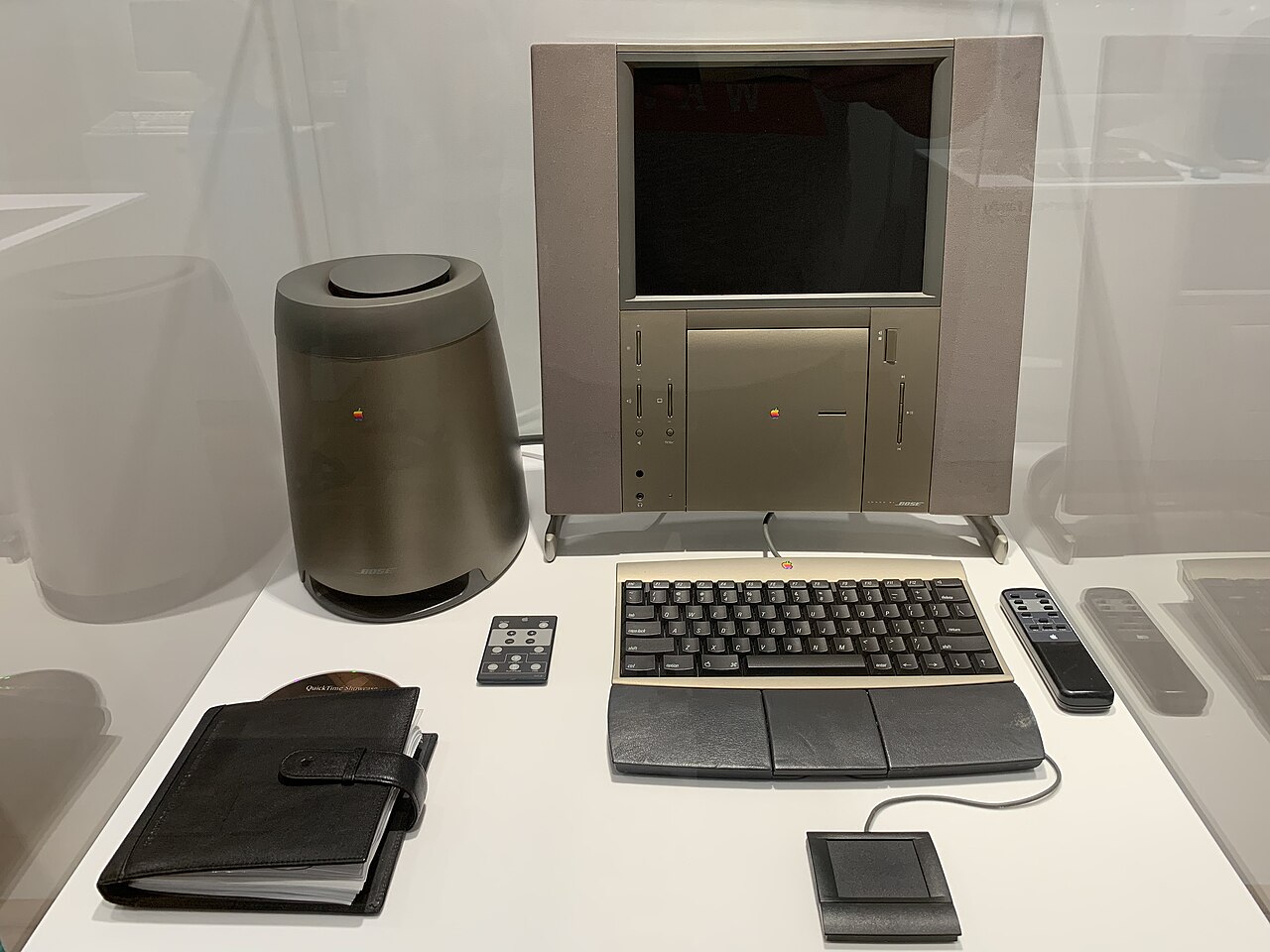
© Benoît Prieur · CC0 1.0 ↗ Resized, no crop or retouching.
Specs
| Chip | PowerPC 603e at 250 MHz, 32 MB RAM · Apple |
| Display | 12.1-inch active-matrix LCD |
| Key feature | Bose Acoustimass sound · Apple |
Launch
Apple announced the Twentieth Anniversary Macintosh at Macworld Expo in January 1997, according to Wikipedia, which records an initial price of $7,499. Macworld’s preview anticipated a price around $9,000 and did not yet describe the final configuration. Apple documents the shipping machine with a 250 MHz PowerPC 603e, 32 MB RAM, a 2 GB drive, and 4x CD-ROM. · Apple
Marketing
Macworld described it as a collector’s piece and reported a plan limited to 20,000 units, a forecast rather than a final production total. Home delivery and setup were part of the concierge service described by Macworld and Wikipedia. Apple confirms Bose Acoustimass sound with an external subwoofer and TV and FM tuners. · Apple
Its reception remained contentious years later. In 2006, PC World included the TAM in the dishonorable mentions of its article on the 25 worst tech products, outside the 25 numbered entries. It criticized the roughly $7,500 price against a weak processor, no network card and a slow CD-ROM drive. This was the magazine's retrospective judgment, not an objective ranking of the computer.
Flaws and fixes
According to Wikipedia, the price fell to about $3,500 during its commercial life. When it was discontinued in March 1998, remaining stock was cleared at $1,995 and US dealers sold out within two weeks. These are historical prices and timings reported by that source, not global sales figures.
Apple's Service Source documentation required any service involving removal of enclosure screws to be handled by a centralized repair center. Detailed repair instructions were therefore not distributed on the Service Source CD. This was a documented service policy, not proof that users could not install memory or expansion cards.