Apple announced Xserve RAID on February10,2003, with availability planned for March. It was a3U storage array, not another Xserve computer or an Ethernet file-serving NAS. This page covers the original180GB ATA/100 drive offer, not later7TB or10.5TB capacities backdated to launch.
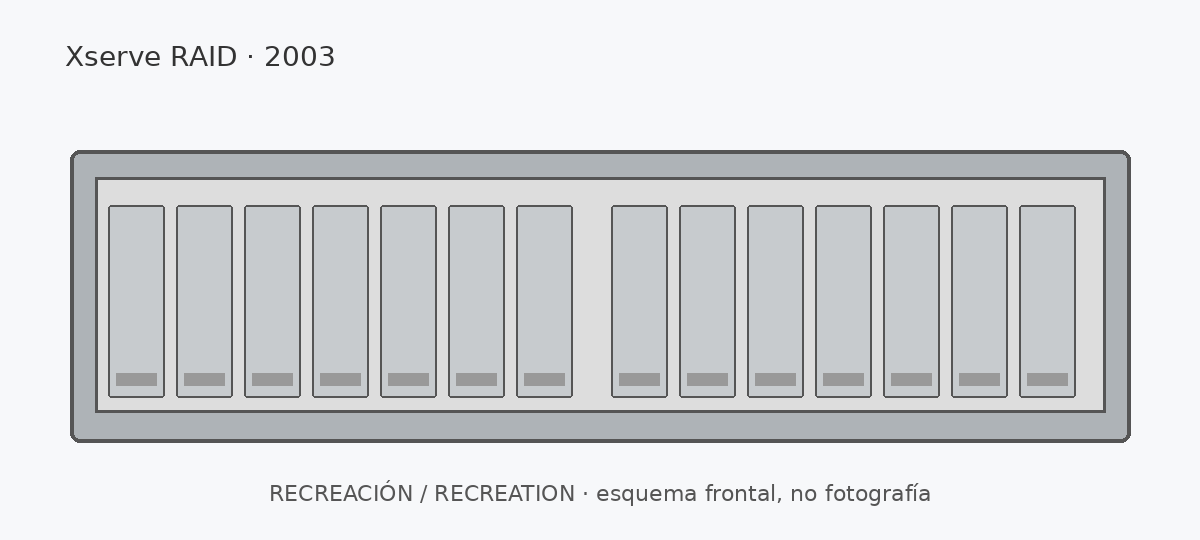
Original schematic front recreation, not a photograph;14trays in2groups of7. Exact ports and indicators not shown. dimensionapple.com.
Original schematic front recreation, not a photograph;14trays in2groups of7. Exact ports and indicators not shown. dimensionapple.com.
Specs
Key feature
Original ATA/100 180GB
Announcement
2003-02-10
Planned availability
2003-03 (planned)
Type
3U · storage array
Drives
4 /7 /14×180GB ATA/100
RAID 0 capacity
720 /1260 /2520GB RAID0
Initial US price
5999 /7499 /10999USD (USlaunch)
Cache
128MB ×2; max512MB/controller
Data links
2×2Gb/s FibreChannel
Management
10/100Ethernet ·RAIDAdminJava
Separate host card
AppleFibreChannelPCI ·499USD (separate)
RAID
0 /1 /3 /5 /0+1
Dimensions and weight
133 ×483 ×442mm ·27–45kg
Announcement and role
Apple announced Xserve RAID on February10,2003, with availability planned for March. It was a3U storage array, not another Xserve computer or an Ethernet file-serving NAS. This page covers the original180GB ATA/100 drive offer, not later7TB or10.5TB capacities backdated to launch.
Capacity and price
The US offer had four, seven or fourteen180GB modules for$5999,$7499 or$10999. Apple listed720,1260 or2520GB total RAID0 capacity, not equivalent usable RAID5 space or a promise of formatted data capacity. Each independent controller managed sevenATA/100 channels; the announcement listed128MB cache per controller, expandable to512MB. Two controllers are not interpreted here as automatic takeover of the other controller’s drives.
Connection and management
Host data used two2Gb/s FibreChannel links. Apple’s FibreChannel PCI card was sold separately for$499 in the announcement, so the array’s starting price does not describe the complete required host system.10/100Ethernet was for remote management. Java-based RAIDAdmin handled configuration, events and alerts; redundant hot-swappable power and cooling were offered. “Up to400MB/s” is Apple’s announced figure, not guaranteed performance for every RAID and workload.
Design, relation and image
The manual describes RAID0,1,3,5 and0+1 per controller, fourteen bays and133 ×483 ×442mm dimensions (height ×width with brackets ×depth), weighing27–45kg depending on modules. The existing XserveG4 is a related host computer, not a predecessor or the same product; no generational comparison is forced between different roles. The image is an original front-panel recreation with fourteen trays in two groups of seven. Schematic, not a photograph or a depiction of exact ports, indicators or drives.