
Apple LaserWriter (1985)
A key part of desktop publishing: Adobe PostScript, a Canon laser engine, and AppleTalk networking to share the printer among Macs.
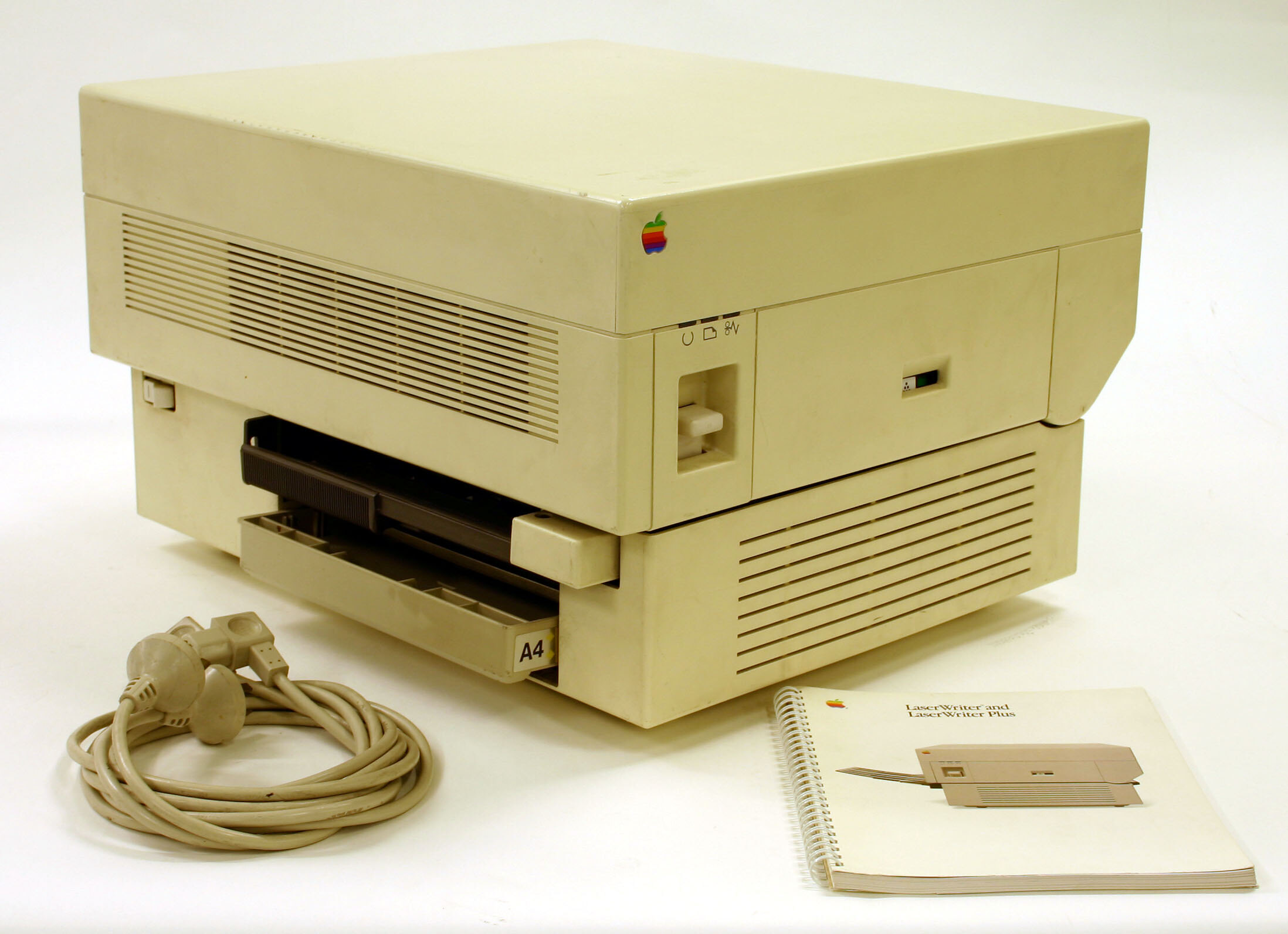
© Museums Victoria · CC BY 4.0 ↗ Resized, no crop or retouching.
Specs
| Connectivity | LocalTalk (AppleTalk) and serial |
| Resolution | 300 dpi, 8 pages per minute |
| Key feature | Motorola 68000 at 12 MHz · PostScript · Apple |
Launch
Apple unveiled the LaserWriter on January 23, 1985, at its annual shareholders' meeting at Cupertino's Flint Center, with the Pointer Sisters on stage and all twenty-seven Adobe employees in the audience, per Adobe's history as told by Macworld. The PostScript licensing deal had closed in December 1983, and that same day Aldus announced PageMaker, the other half of the equation, per Wikipedia. Units shipped in March 1985 at $6,995: expensive in absolute terms, but cheap next to IBM and Xerox lasers costing three to ten times more, and analysts soon praised its near-typeset quality, again per Macworld. Apple dates its introduction to March 1, 1985.
The project had been brewing in secret for months: in the summer of 1984 Jobs urgently called Jonathan Seybold, the electronic-publishing figurehead, and showed him a Mac connected to a LaserWriter in a small room in Cupertino, with John Warnock present, per Seybold's account as retold by Macworld. Apple already had its Adobe deal, was signing another with Linotype and had real fonts; Seybold recalls understanding instantly that publishing had just changed forever. Macworld frames the outcome as three upstart companies (Adobe, Aldus and Apple) joining forces to create desktop publishing in 1985.
Marketing
The commercial key was sharing: over LocalTalk cabling, one LaserWriter could serve up to sixteen Macs, bringing the per-user cost under $450; far below a personal laser printer; per Wikipedia's account of era literature. Museums Victoria sums up the effect: the LaserWriter with PostScript, the Mac, and PageMaker (July 1985) did in minutes what traditional typesetting took hours, and the Computer History Museum places it among the pieces that gave birth to desktop publishing. Inside, it was a serious computer: a Motorola 68000 at 12 MHz with 1.5 MB of RAM, per Apple's technical specifications; Apple's computer of greatest capacity of its time, in the museum's words.
Macworld reconstructs the context: before the LaserWriter only three companies had released laser printers (IBM in 1979, Xerox with its Star in 1981 and HP with the LaserJet in 1984, which shared the same Canon engine as the LaserWriter), and all three lacked the essential piece: an affordable, graphical personal computer like the Macintosh. The Adobe alliance went beyond a license, too: Apple came to own 16.4% of the company, a stake whose planned sale it announced in 1989, per The New York Times.
Flaws and fixes
The $6,995 price limited affordability, although networking allowed the cost to be shared, according to Macworld and Museums Victoria. Apple lists a weight of 77 lb (about 35 kg) and power of 760 W, factors to consider when installing it. Apple’s technical sheet lists the original LaserWriter as discontinued on February 1, 1988. According to Wikipedia, the family expanded with new models and ended in 1997, in a market where other manufacturers also offered PostScript and Ethernet.
Apple's technical sheets document the succession: the January 1988 LaserWriter IISC used a 68000 at 7.45 MHz, QuickDraw and SCSI. The IINT had a 68000 at 11.5 MHz, 2 MB of RAM and PostScript; the IINTX used a 68020 at 16.67 MHz, 2–12 MB and Diablo 630 and HP LaserJet emulation alongside PostScript. In October 1991 the IIg arrived with a 68030 at 25 MHz, PostScript Level 2, PCL 4+, LocalTalk and Ethernet.