
SoundSticks (2000)
The Mac's transparent speakers: two four-driver towers and a revised iSub, designed with Apple and awarded for their design the very year they launched.
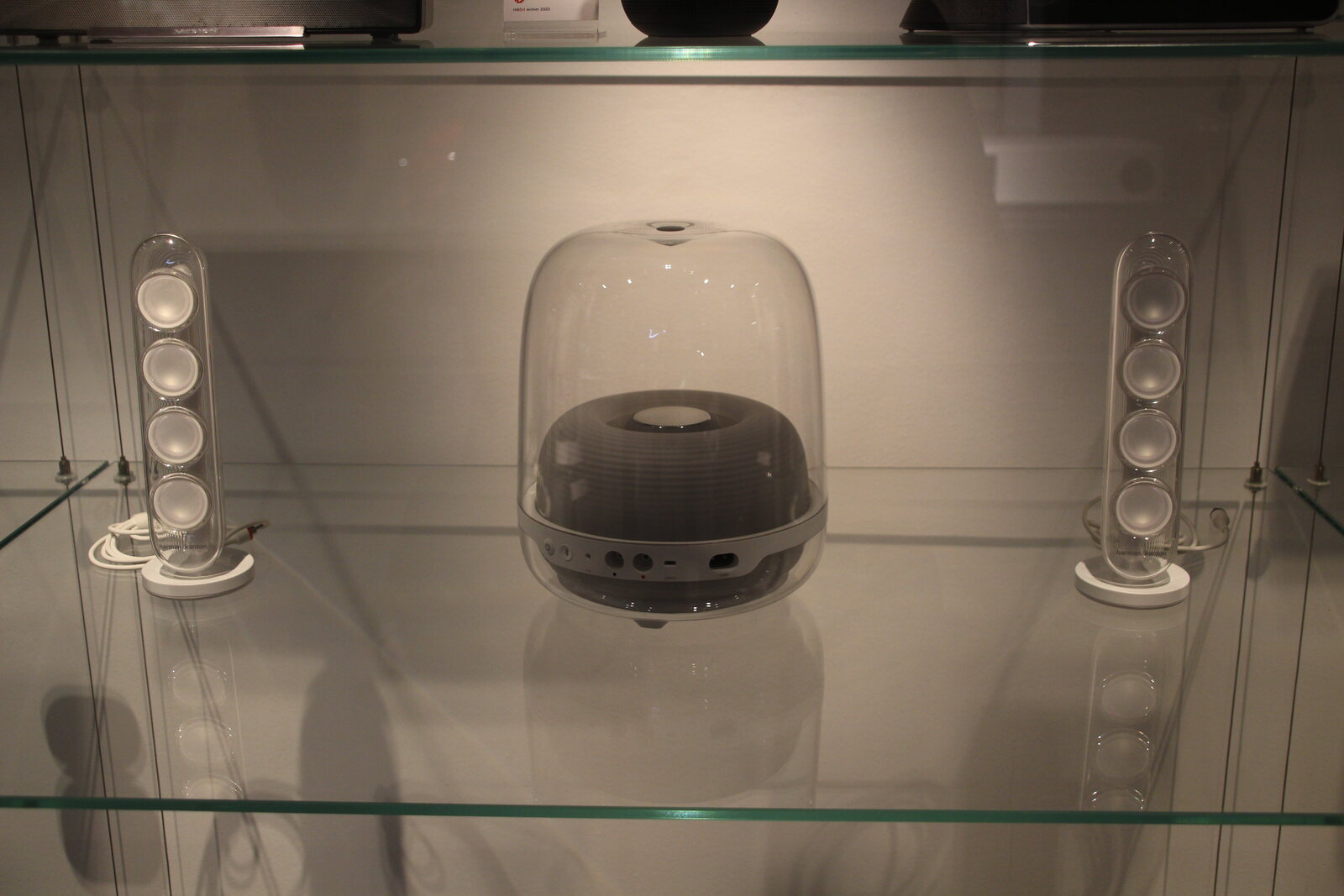
© Wikisympathisant · CC BY-SA 4.0 ↗ Resized, no crop or retouching.
Specs
| Connectivity | USB (digital audio) · 40 W total |
| Price | $199 |
| Key feature | Apple-led design, built by Harman Kardon |
Launch
Harman Kardon and Apple introduced the SoundSticks at the July 2000 Macworld Expo in New York, per ITespresso's coverage at the time; the July 19 keynote survives on the Internet Archive. They went on sale that same month for $199, per the record collected by Wikipedia. The system completed what the 1999 iSub had started: a new revision of that subwoofer, now at 20 watts, plus two tilting 10-watt satellite towers with four 1-inch transducers each, per Macworld's earlier coverage. The practical key was compatibility: they worked with any USB-equipped Mac running Mac OS 9.0.4, and with Mac OS X too, no longer just with slot-loading iMacs like the original iSub. Apple led the industrial design with Jonathan Ive, per ITespresso.
Marketing
They were sold by both brands as the reference sound system for the Mac, and the design earned immediate recognition: an award at the 2000 Industrial Design Excellence Awards and the cover of I.D. magazine, per coverage collected by Wikipedia. Reviews backed it up: in 2001 The Mac Observer praised crystal-clear sound without audible distortion and strong results with music and movies, though it criticized a price above comparable systems, and in 2002 CNET gave them four stars for easy setup, design and audio quality. The set ended up in museums: in 2013 New York's MoMA added an iSub to its collection. Apple kept selling the SoundSticks until 2015, and Harman Kardon maintains the line to this day, with revisions in 2004, 2009, 2012, 2020 and 2025.
Flaws and fixes
Design purity had an everyday cost: the satellites had no physical volume controls, as Macworld's October 2000 review noted; overall volume was adjusted from the Mac's Sound panel and only the bass module had its own knob. CNET also criticized limited support for Windows PCs, per coverage collected by Wikipedia. The line fixed it in hardware: the 2004 SoundSticks II replaced the USB input with a standard 3.5 mm jack, opening them to any source, and added capacitive volume buttons on the right satellite.