
Apple Pippin (1996)
A Macintosh-based multimedia platform, designed by Apple and marketed by Bandai under license.
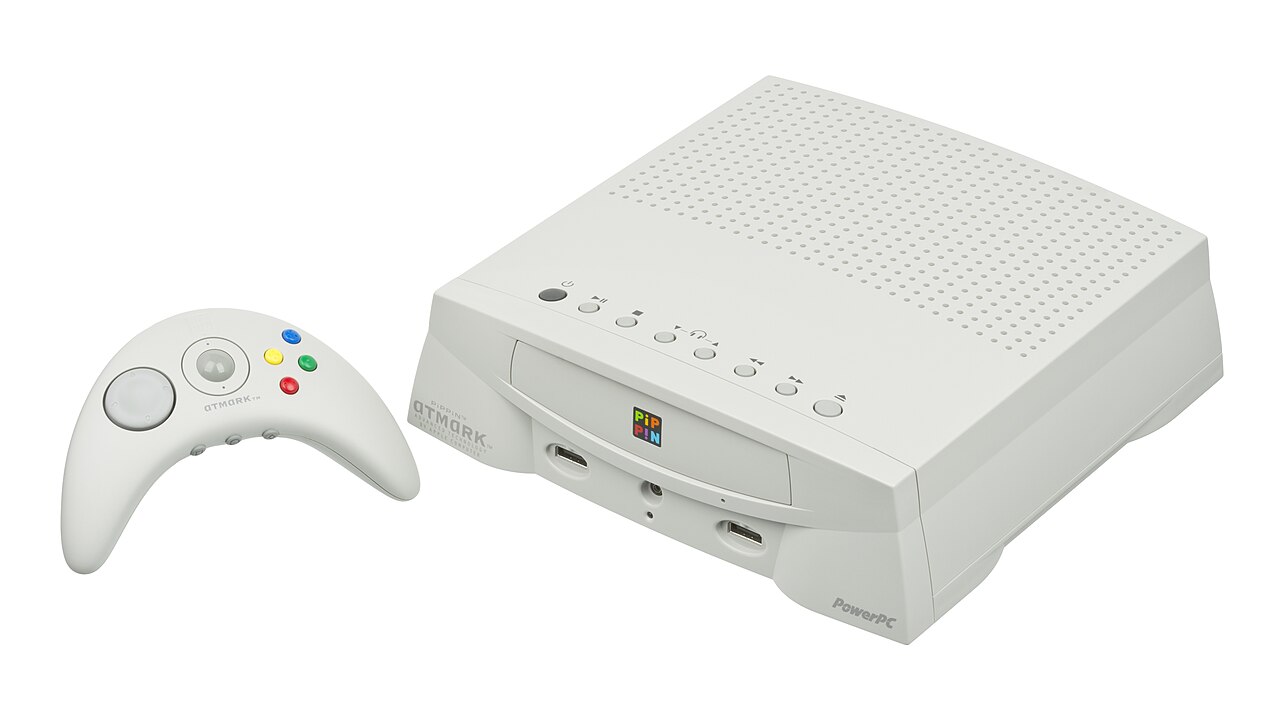
© Evan-Amos · Public domain Resized, no crop or retouching.
Specs
| Chip | PowerPC 603 at 66 MHz, 6 MB RAM |
| System | Mac OS System 7.5.2 loaded from 4x CD-ROM |
| Key feature | TV video output · 14.4 kbps modem · Wikipedia |
Launch
Apple announced the Pippin platform in Tokyo on December 13, 1994, with Bandai as its first partner, per Wikipedia. The idea, reconstructed by Ars Technica from those involved: Apple led engineering and design and collected a per-unit license fee, while Bandai took on manufacturing, branding and marketing. The white ATMARK went on sale in Japan in March 1996 at 64,800 yen with a modem and four CDs, and on June 18, 1996 Bandai announced the black @WORLD for the United States: with availability planned for September at $599, with a web browser and a PSINet Internet access CD, per its press release. · Bandai (1996)
Marketing
It was not just a console: with a 14.4 kbps modem and a browser, Bandai sold it as a gateway to the Internet from the living-room TV, including email and word processing through the TV Works software, per its press release. Ars Technica recounts that Apple even advised against the Internet focus and that Bandai was the one who insisted on the modem. The catalog mixed games and educational CD-ROMs, and Apple also licensed the platform to Katz Media, whose KMP 2000 targeted kiosks and vertical markets, per Wikipedia. · Bandai (1996)
Flaws and fixes
To keep it from competing with the Mac, Apple limited it: no hard drive, one application in memory at a time, and the operating system loaded from each CD, as Ars Technica details. Ars Technica describes the difficulty of positioning it between a dedicated console and a computer. According to Wikipedia, Bandai stopped production in mid-1997 and remaining inventory went to DayStar Digital in February 1998. Published sales estimates do not agree.